Quick summary
- Agent apps and Copilot experiences in Slack and Teams suggest that AI is moving to the places where software work is assigned, reviewed, and coordinated. The benefit depends on keeping clear human control points.
- Embedding agents in delivery workflows can reduce context switching, but it also connects AI directly to decisions affecting code, security, and releases.
- Pilot an agent for issue triage or rollout preparation, and require every material recommendation to link back to its source issue or pull request.
What happened
GitHub is placing agents closer to the chain of work that gets software to production. This is not only about coding assistance: agent apps are presented for scoping, securing, rolling out, and shipping a feature inside GitHub.
With Copilot also appearing in Slack and Microsoft Teams, the boundary between discussing work and carrying it out is getting thinner. That can reduce context switching, but it makes accountability a design concern from the start.
From coding help to delivery flow
GitHub's agent apps guide uses four apps to illustrate feature work across the SDLC, from scope through security and rollout to shipping. The significant positioning is that agents can coordinate across stages, rather than merely generate code.
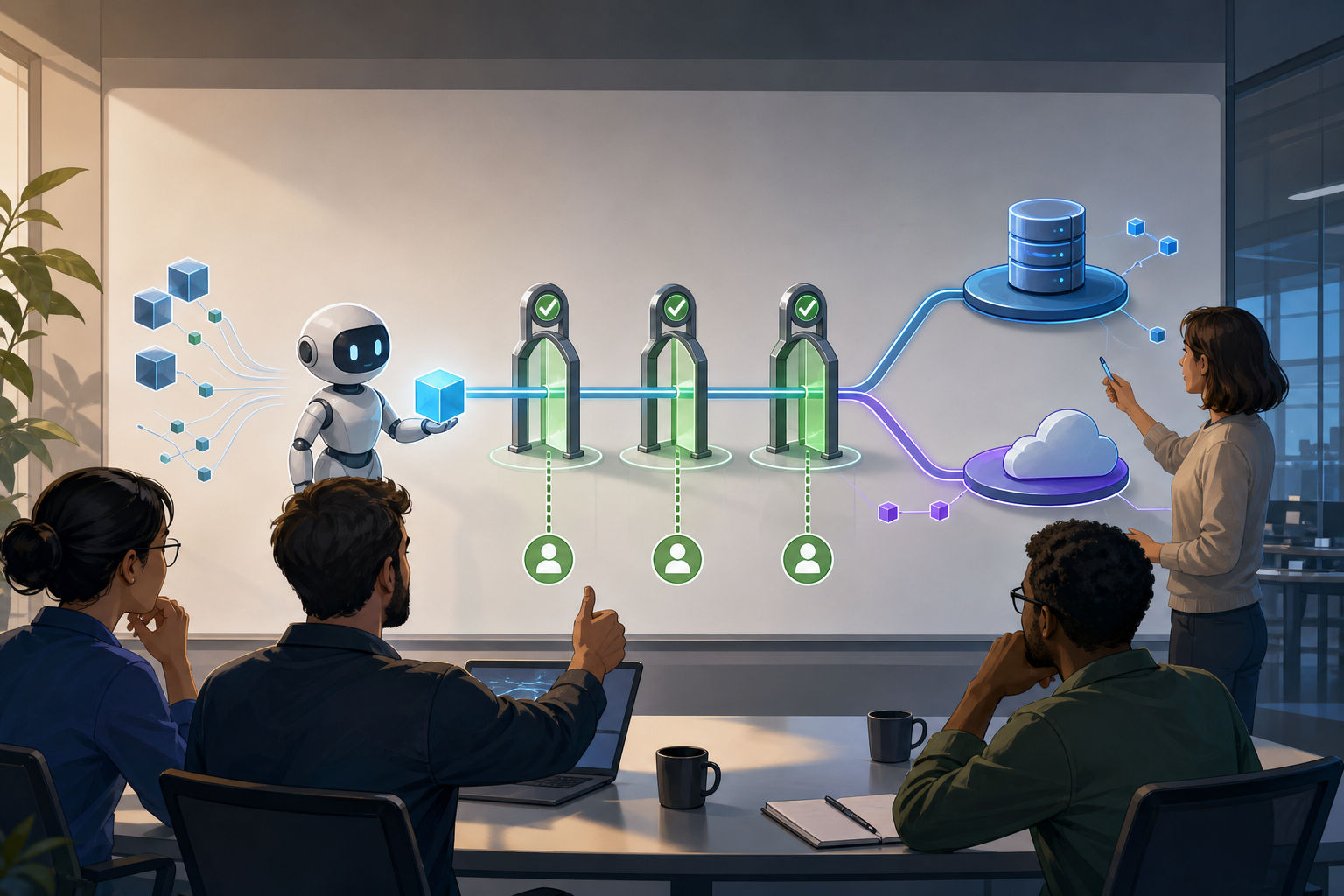
That does not imply an agent should own the process. Each stage has a different standard of success: scope needs correct requirements, security needs evidence, rollout needs observation, and release needs an accountable decision.
Collaboration becomes another context layer
The new GitHub Copilot experience in Slack and shared agentic work in Teams bring agents to the team communication layer. Operationally, that can keep questions, decisions, and work status closer together.
Conversation is not a perfect system of record, however. A chat decision may be incomplete, superseded, or unapproved. Impactful actions should therefore resolve to a structured artifact such as an issue, pull request, policy, or change record.
Design checkpoints instead of vague autonomy
A useful pilot divides work into states. An agent may summarize issues, suggest a security checklist, or prepare a rollout plan, while a human owner approves a status change or any consequential tool call.
| Stage | Appropriate agent role | Required control |
|---|---|---|
| Scope | Summarize requirements and gaps | Product-owner confirmation |
| Security | Propose review areas | Independent security review |
| Rollout | Draft plan and signals | Owner approval for changes |
| Release | Compile status | Accountable human decision |
How to start without complicating the SDLC
Choose a measurable bottleneck, such as issue triage or release-note preparation. Keep input data narrow, require links to the underlying artifacts, and measure user edit rates rather than simply counting agent responses.
Only expand to another SDLC step if the agent removes repetitive work without obscuring who decided what.
In 5 Minutes
- GitHub positions agent apps across SDLC stages, not just code generation.
- Slack and Teams can add collaboration context but should not become the sole decision record.
- Connect agent actions to artifacts and owner-controlled checkpoints.
- Begin with one measurable, low-risk bottleneck.
Sources
- Cloudflare AI Search: give your agents a search engine for your data
- The next generation of MCP
- Building an open Agentic Internet: readable, discoverable, callable, and payable
- How to bring your software delivery workflow into GitHub with agent apps
- The new GitHub Copilot experience in Slack
- Shared agentic work with GitHub Copilot in Microsoft Teams
- Introducing Agent Plugins
- Introducing the new v0 API
Why developers should care
Embedding agents in delivery workflows can reduce context switching, but it also connects AI directly to decisions affecting code, security, and releases.
Recommended action
- 1Pilot an agent for issue triage or rollout preparation, and require every material recommendation to link back to its source issue or pull request.