Quick summary
- Banksalad presents Salad Game DSL as a way to preserve creative freedom without giving up engineering stability. The broader lesson is that production-ready vibe coding needs a constrained, reviewable interface between an AI-generated intention and the system that executes it.
- AI-generated code is difficult to govern when it can alter an application without clear boundaries. A domain-specific language can narrow the allowed change surface, support automated validation, and give reviewers a more predictable artifact to assess.
- Review Banksalad’s original framing, then prototype the DSL pattern on one low-risk workflow with strict validation, isolated testing, human approval, telemetry, and rollback.
What happened
Vibe coding is easy to embrace during exploration and much harder to authorize in a production engineering organization. The bottleneck is not how quickly an AI can propose an implementation; it is whether the team can understand, validate, approve, and reverse the resulting change.
Banksalad’s engineering post introduces Salad Game DSL as an attempt to retain both freedom and stability. The supplied source summary does not expose its syntax or implementation architecture, so the useful takeaway is the design direction rather than an unverified reconstruction of the tool: constrain AI-assisted creation to an organization-owned domain boundary.
What turns vibe coding into an approved workflow?
In this context, “legal” is best read as sanctioned by an engineering organization, not as a legal opinion. An approved workflow specifies what the AI may change, what evidence is required, who accepts the change, and how the team recovers when the result is wrong.
That distinction separates experimentation from software delivery. A prototype can tolerate manual fixes and incomplete context; a production path must account for dependencies, access control, testing, deployment, monitoring, and ownership. Giving a model a coding interface does not satisfy those requirements by itself.
A written AI policy is also insufficient if the underlying tools can bypass it. Effective governance needs executable controls: limited operations, machine-checkable output, mandatory review gates, and an escalation path for requests that fall outside the supported domain.
Why put a DSL between the model and the application?
A domain-specific language represents a deliberately narrow problem space. That narrower vocabulary can reduce the number of ways an AI-generated intention becomes executable behavior, making the result easier to inspect than arbitrary changes spread across a general-purpose codebase.
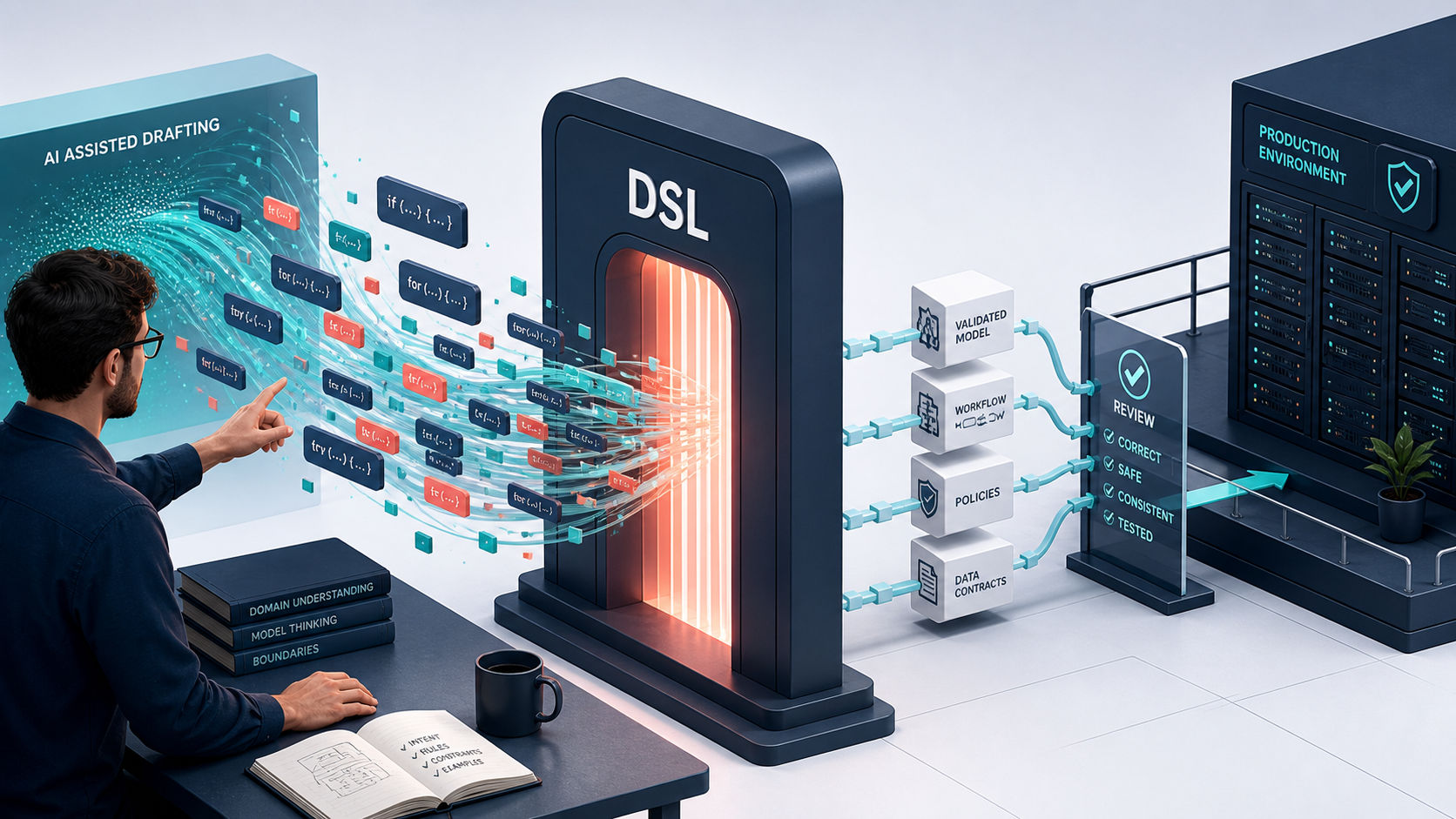
Conceptually, a DSL can serve as a contract. A person supplies the goal, an AI drafts a domain-level representation, validation rejects unsupported structures, and organization-owned software interprets the accepted artifact. This is a general architectural model, not a claim that Salad Game DSL implements every stage in exactly this form.
The boundary matters because syntactic freedom and operational authority are different things. A model may be allowed to compose approved elements without receiving permission to introduce dependencies, touch credentials, change deployment configuration, or call unrestricted services. The DSL’s vocabulary becomes one place where those decisions can be made explicit.
Still, a DSL is not a security boundary merely because it has a custom syntax. Its parser, validator, runtime behavior, resource access, and escape hatches all need review. An expressive shortcut that executes arbitrary code can quietly restore the same risk the abstraction was meant to remove.
What would a defensible delivery path look like?
The source material provided here is not detailed enough to document Banksalad’s internal pipeline. The following is therefore a recommended evaluation pattern for teams considering the same design principle, rather than a description of Banksalad’s production system.
- Bound the domain: select repetitive, well-understood tasks and explicitly exclude sensitive or ambiguous operations.
- Generate a draft: let the model produce only the approved domain representation, while preserving the user’s original request for review.
- Validate before execution: reject malformed structures, unknown references, prohibited combinations, and unsupported versions.
- Test behavior: run suitable automated checks or isolated previews; a valid document is not necessarily a correct result.
- Require accountable approval: record the reviewer, language version, generator context, test outcome, and release decision.
- Observe and reverse: monitor the deployed behavior and maintain a reliable rollback path.
This resembles the controls required for production AI agents. Prompts communicate intent, but permissions, tool boundaries, verification, and recovery determine operational safety. The same lesson applies to web systems built on increasingly capable browser-native APIs: a high-level instruction does not remove the need to test against the real runtime.
Error classification is another practical requirement. Teams should distinguish a poor model proposal from a deficient DSL specification, a validator defect, and a runtime failure. Without that separation, every incident is blamed on “the AI,” and the organization cannot identify which control needs improvement.
Where can the DSL approach fail?
A new language creates its own platform obligations. Someone must own the grammar, documentation, validation rules, diagnostics, compatibility policy, execution layer, and incident response. If the target domain changes constantly, that maintenance cost may exceed the benefit of constraining it.
| Evaluation area | Question to answer |
|---|---|
| Coverage | Can the language express common target tasks without frequent escape hatches? |
| Determinism | Does an accepted representation produce predictable, testable behavior? |
| Diagnostics | Can developers and AI tools act on validation errors? |
| Compatibility | What happens to existing artifacts when the language evolves? |
| Authority | Which data, services, and side effects can the runtime reach? |
| Ownership | Who supports the language and responds when execution fails? |
Teams should also measure outcomes rather than relying on the apparent speed of generation. Useful signals include rejection rates, defects found after validation, review effort, failed releases, and recovery time. Those measurements should be interpreted alongside ordinary web performance and infrastructure costs, an approach consistent with treating memory, storage, and cost as measurable optimization inputs.
The safest adoption strategy is narrow and reversible. Start with a domain where outputs are easy to preview and consequences are limited, then expand only after the controls demonstrate that they catch meaningful failures.
Conclusion
- Banksalad frames Salad Game DSL as a way to combine creative freedom with engineering stability.
- A DSL can make AI output narrower and more reviewable, but it does not guarantee correctness or security.
- Validation, testing, accountable approval, observability, and rollback remain essential.
- Adopt the pattern in a small domain and expand based on measured results.
Related reading
- Browser-native APIs are reshaping interactive web development
- Web cache optimization now starts with measurable memory, storage, and cost
Source
Why developers should care
AI-generated code is difficult to govern when it can alter an application without clear boundaries. A domain-specific language can narrow the allowed change surface, support automated validation, and give reviewers a more predictable artifact to assess.
Recommended action
- 1Review Banksalad’s original framing, then prototype the DSL pattern on one low-risk workflow with strict validation, isolated testing, human approval, telemetry, and rollback.