Quick summary
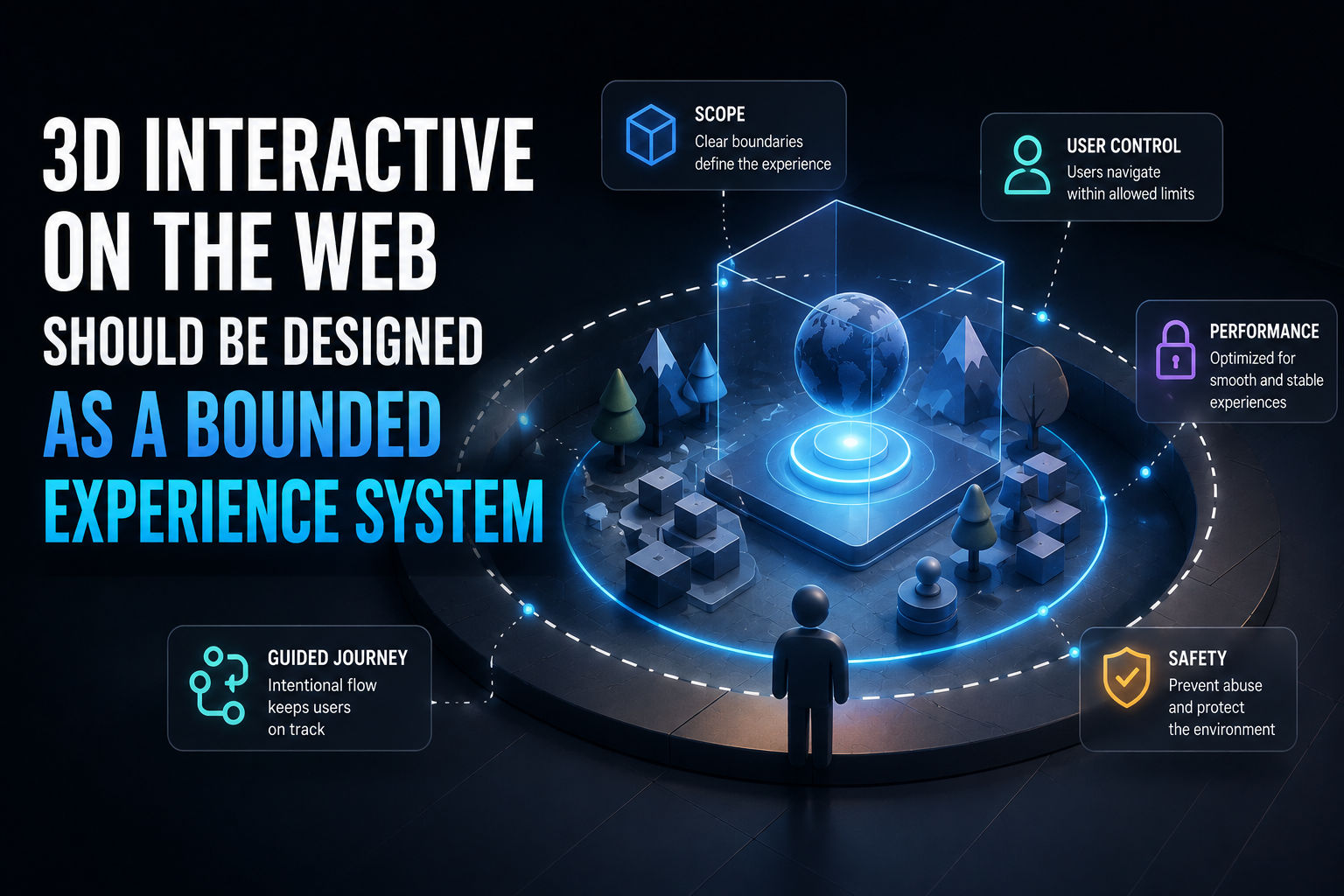
- Recent Three.js projects—from fly-through games to depth-map relighting—show how web 3D can create rich interaction. Product use requires managing initial load, navigation, motion, and alternatives as one system.
- A 3D effect creates value only when people can still understand content, complete tasks, and get a stable experience across conditions.
- For each 3D proposal, write an experience hypothesis, a non-3D version, and comparative measures for load, input response, and task completion.
What happened
Three.js is being used for distinctly spatial web experiences: a game built around fly-throughs, image relighting with depth maps, and interactive 3D clusters. They illustrate the storytelling range of real-time rendering.
But interactive does not automatically mean appropriate as the primary interface. The experience needs both technical and user-centered constraints.
Start with 3D’s role in the user journey
3D can work well for exploration, context, and feedback in a creative task. It is less effective when it makes people learn spatial navigation to complete a task that a two-dimensional UI could communicate clearly.
Before building the scene, write one sentence describing its value: what does the person understand, explore, or decide better because of this 3D element? Without an answer, the effect may be cost without utility.
Motion needs a cadence and an exit
Animation, fly-throughs, and camera response can add depth. They can also delay orientation or become uncomfortable when the user cannot control their pace.
Design should support stopping, skipping, or using a static view when motion is not serving the task. That is an experience decision before it is an implementation detail.
Asset loading is part of rendering design
A 3D scene can bring geometry, textures, shaders, and runtime logic. Loading strategy therefore matters as much as drawing strategy: load what the current intent needs, defer the rest, and do not make an ancillary scene a prerequisite for readable content.
This is where rendering architecture meets product architecture. People should receive value before their device is asked to render a complete world.
A safe trial checklist
- Can core content or action work without 3D?
- Does the user control motion and camera behavior?
- Does the loading path prioritize initial value?
- Are startup, input response, and task completion measured separately?
In 5 Minutes
- 3D needs a specific role in the user journey.
- Motion should be controllable, skippable, and task-safe.
- Asset loading belongs to rendering architecture.
- Trial 3D first in non-critical flows.
Image brief for editors
These production notes are not part of the published article. Create and insert the images before approval.
Thumbnail
Suggested placement: Article cover image
Image prompt: Editorial cinematic 3D corridor with a clear navigable route, a viewer silhouette, and calm static side paths, abstract lighting, no text, logos, UI, or screenshots
Suggested alt text: A 3D space with a clear navigable route and calm static alternative views.
In-article image 1
Suggested placement: After the “Start with 3D’s role in the user journey” section
Image prompt: Conceptual illustration of a 3D scene assembling in layers from simple geometry to richer spatial detail, with core content visible first, no text or interface elements
Suggested alt text: A 3D scene assembling gradually from simple geometry to richer detail.
Sources
- Sixty Frames for the Record: A Three.js Game, Seven Fly-Throughs, and a Wall of CRTs
- Run Rob Run: Building a Music-Reactive Goo with Three.js and WebGPU
- Relighting Images with Depth Maps and Three.js
- Creating an Interactive 3D Cluster with Three.js, TSL and Three Start
- Exploring Procedural Geometry with Three.js and WebGPU
- Garden Anomaly: A Tiny WebGPU and TSL Experiment
- High-Frequency Real-Time Data in React: From Ring Buffers to OffscreenCanvas
Why developers should care
A 3D effect creates value only when people can still understand content, complete tasks, and get a stable experience across conditions.
Recommended action
- 1For each 3D proposal, write an experience hypothesis, a non-3D version, and comparative measures for load, input response, and task completion.