Quick summary
- Anthropic describes Claude Fable 5.1 and Claude Mythos 5.1 as its most advanced models for coding and knowledge work, with research capabilities that could point toward scientific applications. The supplied announcement does not establish pricing, access, benchmarks, or a division of roles between the models, so production decisions should wait for evidence and workload-specific testing.
- Better coding and research models could reshape developer assistants and knowledge workflows, but model claims alone do not establish production value. Engineering teams need verified capabilities, system-level cost measurements, and robust controls before adoption.
- Monitor Anthropic's official API, pricing, limits, and benchmark documentation, while preparing a controlled evaluation set drawn from your own repositories and knowledge workflows.
What happened
Anthropic has introduced Claude Fable 5.1 and Claude Mythos 5.1, calling them its most advanced models for coding and knowledge work. The company also frames their research capabilities as an early indication of how AI models might contribute to scientific progress.
The positioning is consequential, but the supplied material establishes only those high-level claims. It does not provide the operational and comparative details developers need to select a model, estimate costs, or approve a production migration.
What does the announcement establish?
Anthropic's Claude Fable 5.1 and Claude Mythos 5.1 announcement identifies two new model names and connects them to coding, knowledge work, and research. Its reference to science is forward-looking: it presents the models as a glimpse of possible contributions rather than documenting a specific, independently validated scientific discovery.
The supplied announcement summary does not explain how Fable and Mythos differ. There is consequently no evidence in the available record that one is the faster option, the more capable option, or a lower-cost tier. Inferring a product hierarchy from the names would go beyond the source.
| Established by the supplied material | Not established by the supplied material |
|---|---|
| Two models with 5.1 versioning | API and SDK availability |
| Positioning for coding and knowledge work | Pricing, latency, and rate limits |
| A claim of research capability | Context limits and tool-calling behavior |
| Potential relevance to scientific progress | Validated scientific outcomes |
These omissions should not be read as proof that the capabilities are absent. They mean only that architecture, benchmarks, access methods, commercial terms, and deployment regions cannot be verified from the evidence supplied for this article.
Why do coding and research belong in the same conversation?
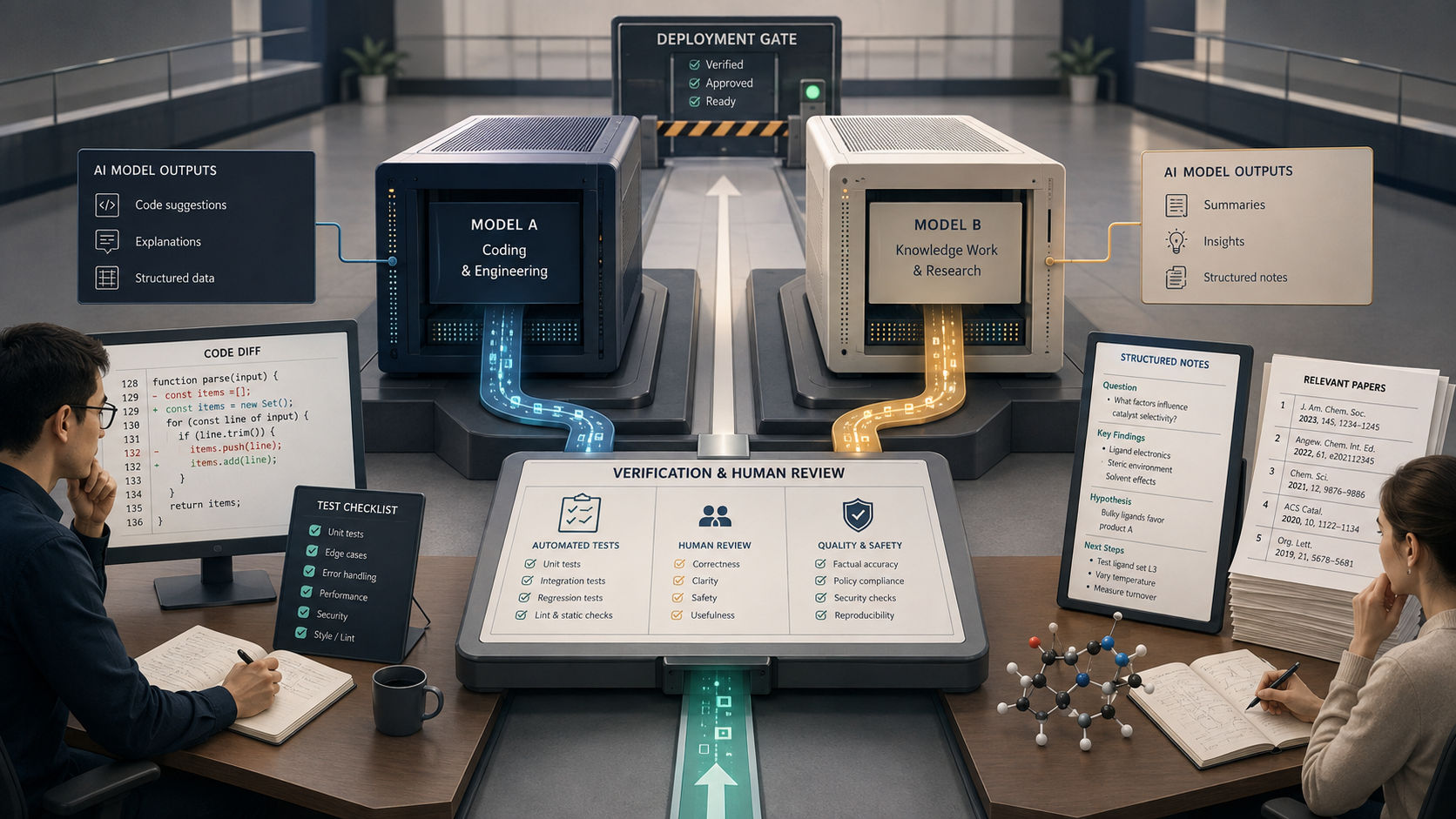
Coding, knowledge work, and research all reward outputs that can be checked rather than merely read. Code can be compiled, tested, and reviewed. A knowledge-work answer can be compared with its supporting documents, while a research result must ultimately survive domain review and attempts at reproduction.
That makes verifiability a more useful evaluation lens than fluency alone. A model may produce convincing prose or plausible code without preserving requirements, grounding conclusions, or handling missing evidence correctly. This is a general engineering consideration, not a confirmed feature or limitation of Fable 5.1 or Mythos 5.1.
For software work, a representative trial would ask the model to diagnose failures, modify multiple files, follow repository conventions, and pass an existing test suite. Knowledge-work trials should test source attribution, contradictory documents, and explicit uncertainty. Research-oriented use demands stricter provenance, reproducibility, and expert oversight because a polished hypothesis is not the same thing as a validated finding.
How should engineering teams evaluate the models?
A vendor's “most advanced” description is a reason to investigate, not a migration criterion. Teams should assemble a compact evaluation set from real issues, pull requests, documents, and failure cases, then compare the new models with the current baseline under equivalent prompts, context, tools, and review rules.
- Task quality: tests passed, defects introduced, factual support, and human corrections required.
- Reliability: variance across repeated runs, behavior with missing context, and recovery from tool errors.
- Operations: end-to-end latency, integration failures, rate constraints, and trace visibility.
- Economics: cost per accepted result, including retries, tool calls, and reviewer time.
- Security: repository scope, secret exposure, data handling, and the reversibility of actions.
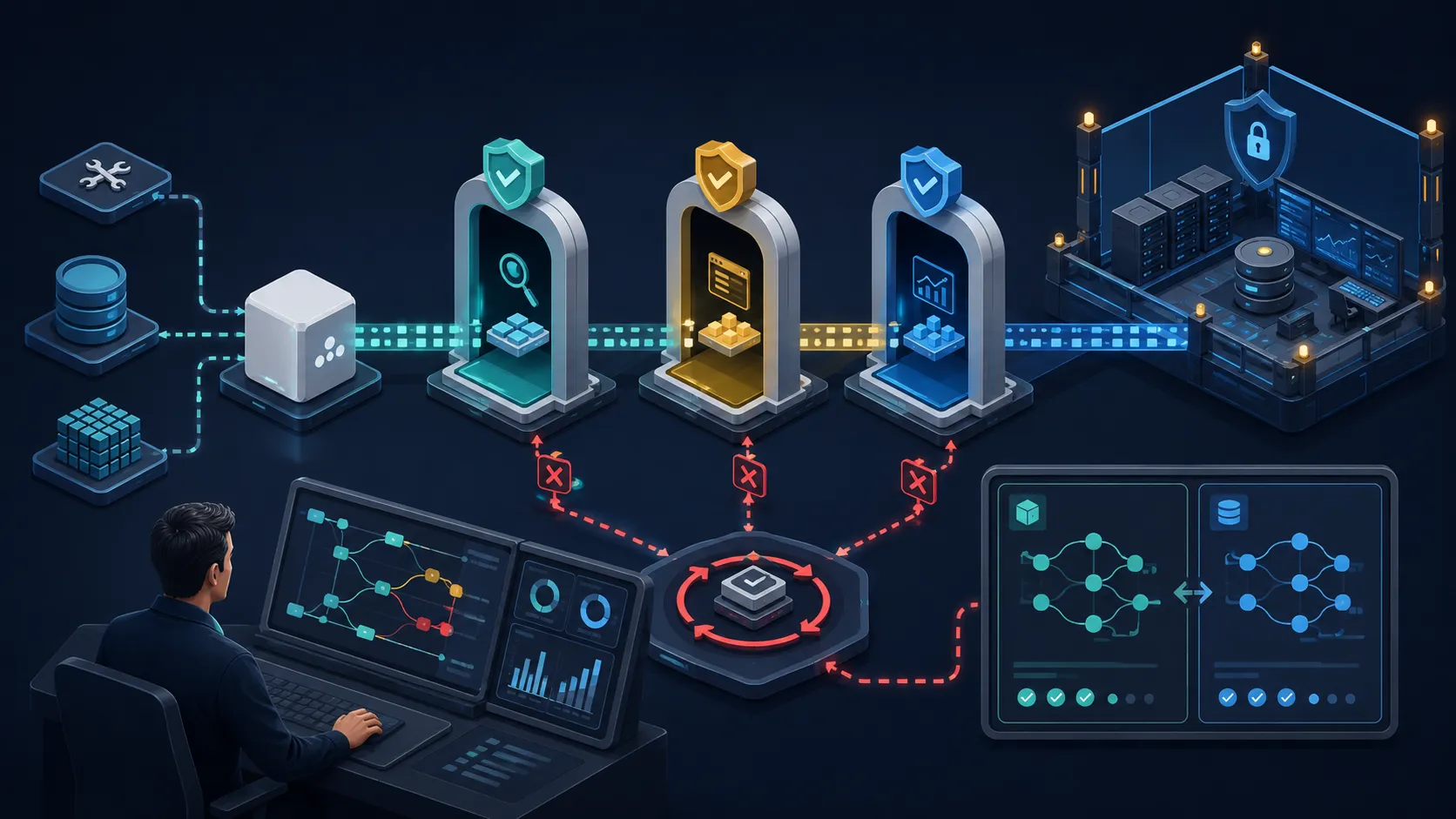
Model capability is only one layer of an agentic system. The discussion of evaluation and production controls for AI agents is relevant because traces, policy enforcement, rollback paths, and adversarial cases must be tested around the model rather than assumed to come from it.
If a workflow can transact or modify external systems, permissions deserve separate scrutiny. Least-privilege credentials, bounded actions, explicit approval for high-impact steps, and auditable records are practical controls; the broader challenge is examined in AI agents that can transact.
What information should developers watch for next?
The next useful disclosures would cover access, limits, evaluation evidence, and commercial terms. Developers need model identifiers and supported interfaces for integration; context and rate limits for architecture; latency and pricing for capacity planning; and data policies for security review.
Benchmark detail matters as much as the headline score. Coding evaluations should identify the repositories, execution environment, test criteria, and contamination controls. Research evaluations should explain data provenance, verification methods, expert involvement, and whether a result was reproduced outside the generating workflow.
Teams should also look for documentation about retention, training use, regional processing, auditability, and failure behavior before submitting proprietary code or sensitive documents. Even strong model-level results would not answer every production question: retries, retrieval, tool execution, observability, and human review can dominate the quality and cost of the complete system.
Until those details are available, the low-regret move is to prepare an evaluation harness rather than redesign an architecture around unverified assumptions. That preserves the option to test quickly while keeping procurement and security decisions tied to evidence.
Conclusion
- Anthropic positions Fable 5.1 and Mythos 5.1 for coding, knowledge work, and research.
- The supplied material does not support a comparison of their speed, price, access, or respective roles.
- Potential scientific contribution should not be confused with a validated scientific result.
- Production adoption should depend on representative evaluations, total task cost, data policy, and system controls.
Related reading
- AI Agents Can Now Transact—Control Is the Hard Part
- AI agent engineering shifts toward evaluation and production controls
- AI infrastructure attracts capital as server costs rise
Source
Why developers should care
Better coding and research models could reshape developer assistants and knowledge workflows, but model claims alone do not establish production value. Engineering teams need verified capabilities, system-level cost measurements, and robust controls before adoption.
Recommended action
- 1Monitor Anthropic's official API, pricing, limits, and benchmark documentation, while preparing a controlled evaluation set drawn from your own repositories and knowledge workflows.