Quick summary
- Identity security is moving beyond periodic access reviews toward continuous discovery, centralized reporting, and behavioral detection. Guidance from AWS, Wiz, and Qualys suggests that access governance, identity-source migration, and attack monitoring should be managed as one lifecycle.
- Engineering teams need to know which people and devices have access, where those permissions originate, and whether apparently legitimate identities are behaving in ways that indicate misuse.
- Map current identity-to-access relationships, pilot continuous discovery in one AWS organizational unit or user group, and evaluate behavioral rules on historical telemetry before enabling automated containment.
What happened
Identity security can no longer stop at granting access when someone joins and removing it when they leave. Across cloud accounts, applications, directories, and devices, access state changes continuously, so an inventory that is accurate today can soon become incomplete.
Recent material from AWS, Wiz, and Qualys points in the same direction: combine continuous identity governance with behavior-aware detection. This is not a single product category so much as an operating model for knowing which identities exist, what they can reach, and which activity departs from an expected baseline.
Why are periodic access reviews no longer enough?
Quarterly or annual reviews remain useful for compliance, but they leave a monitoring gap between review cycles. During that interval, users can change roles, groups can gain permissions, new accounts can appear, and an unauthorized device can join under a name that looks ordinary.
AWS addresses the visibility problem in its guidance on automating IAM Identity Center discovery and reporting. IAM Identity Center can work with an external identity provider to centralize authentication and authorization across AWS Organizations, but centralized sign-in does not by itself prove that every assignment remains necessary or well monitored.
A governance layer therefore needs to answer three questions repeatedly: which identities and groups exist, which accounts or applications they can access, and what has changed since the last observation. Periodic reports can remain an important output, while their underlying data is discovered continuously rather than assembled manually just before an audit.
Why is an identity-source migration also a security change?
Moving from the built-in identity store to Active Directory or another external provider can alter user identifiers, group membership, and the way permissions are mapped. AWS's identity-source transition guidance covers Active Directory migration strategies and permission-set automation, connecting the directory change to the AWS authorization model.
The operational risk is broader than a failed login. A mismatched user or group mapping could remove access that a team needs or preserve access inherited from the old model. Teams should capture a pre-migration baseline, record current assignments, reconcile results after each controlled stage, and define a bounded rollback path.
This resembles the design of a governed automation control plane: changes need a trusted source of state, an audit trail, and an approval path. Automation reduces repetitive work, but it becomes a security control only when the organization can identify drift between intended and observed access.
Why can a legitimate-looking device name be misleading?
Wiz reports that adversaries can generate realistic device names that blend into enterprise environments rather than retaining recognizable fingerprints from public tooling. That development weakens Entra ID rules built primarily around naming conventions or lists of suspicious strings.
Behavioral detection changes the question from “What is this object called?” to “How did it appear, and what did it do next?” Defenders may need to evaluate join context, the identity associated with the event, the sequence of subsequent actions, and deviation from normal activity. These are analytical directions rather than universal indicators; thresholds must be tested against each organization's environment.
Qualys likewise positions ETM Identity around faster detection of identity-based attacks. The supplied material does not include a benchmark or enough implementation detail for a product comparison, however. Teams should validate detection coverage and investigation speed with their own telemetry and attack scenarios rather than treating a speed claim as independently established.
What should engineering and security teams implement first?
Start with a queryable access baseline covering identity sources, users, groups, permission sets, accounts, applications, and assignment relationships. Records also need an owner and an observation time so operators can distinguish current access from stale inventory.
- Discover: collect identities and access relationships automatically at a cadence that reflects how quickly the environment changes.
- Reconcile: compare observed access with the intended policy, prioritizing assignments without an owner or a current business purpose.
- Correlate changes: place user creation, group changes, permission assignments, and device joins on a shared timeline.
- Test behavioral rules: replay them against historical data, measure false positives, and reserve automatic containment for high-confidence cases.
- Rehearse migrations: pilot a new identity source with a limited population, compare access before and after, and verify rollback procedures.
Useful internal measures could include the time needed to observe an access change, the share of assignments with an accountable owner, unresolved drift, and identity-alert investigation time. These are operational recommendations, not metrics reported by the cited vendors; targets should reflect the organization's risk profile and staffing.
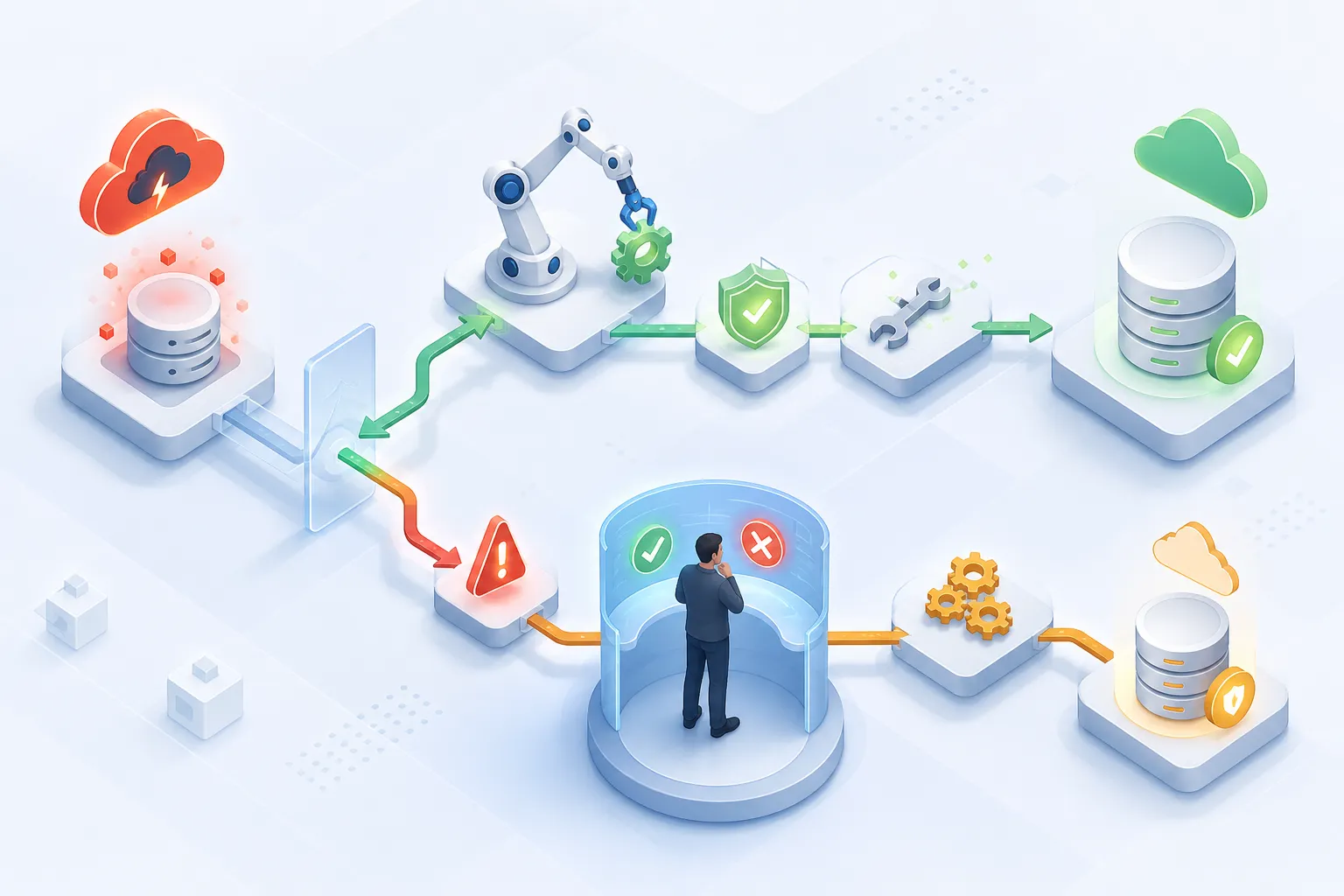
Automation should also preserve human review for disruptive actions. Disabling a user or isolating a device can limit an attack, but an unreliable rule can interrupt production work just as quickly. A staged response—enrich, notify, require approval, then contain—allows a team to increase automation as evidence quality improves.
Conclusion
- Periodic reviews should be backed by continuous identity discovery and reporting.
- An identity-source migration must reconcile users, groups, and permissions, not merely confirm that login works.
- A realistic device name is not evidence of trust; context and behavior are stronger signals.
- Test detections on local telemetry before automatically disabling identities or isolating devices.
Related reading
- Ventura React: Is this lightweight component library still fit for new projects?
- Nova MCP turns Cursor and Claude into a product-building team
- Ansible Automation Orchestrator: Designing a Governed Control Plane
Sources
Why developers should care
Engineering teams need to know which people and devices have access, where those permissions originate, and whether apparently legitimate identities are behaving in ways that indicate misuse.
Recommended action
- 1Map current identity-to-access relationships, pilot continuous discovery in one AWS organizational unit or user group, and evaluate behavioral rules on historical telemetry before enabling automated containment.