Quick summary
- Red Hat is positioning Ansible Automation Platform around coordinated IT workflows, not merely individual automation jobs. DevOps teams should use the shift to examine workflow ownership, approval boundaries, and operational evidence before scaling automation.
- Automation becomes durable when dependencies, controls, and operational accountability are designed as one workflow rather than scattered across jobs.
- Select one cross-system process with multiple handoffs and map its workflow, authorities, and audit evidence before piloting orchestration.
What happened
DevOps teams often begin with useful playbooks and eventually hit a harder problem: a real production change is rarely one automation run. It crosses systems, owners, and control points. Red Hat’s current Ansible Automation Platform direction puts that coordination layer at the center.
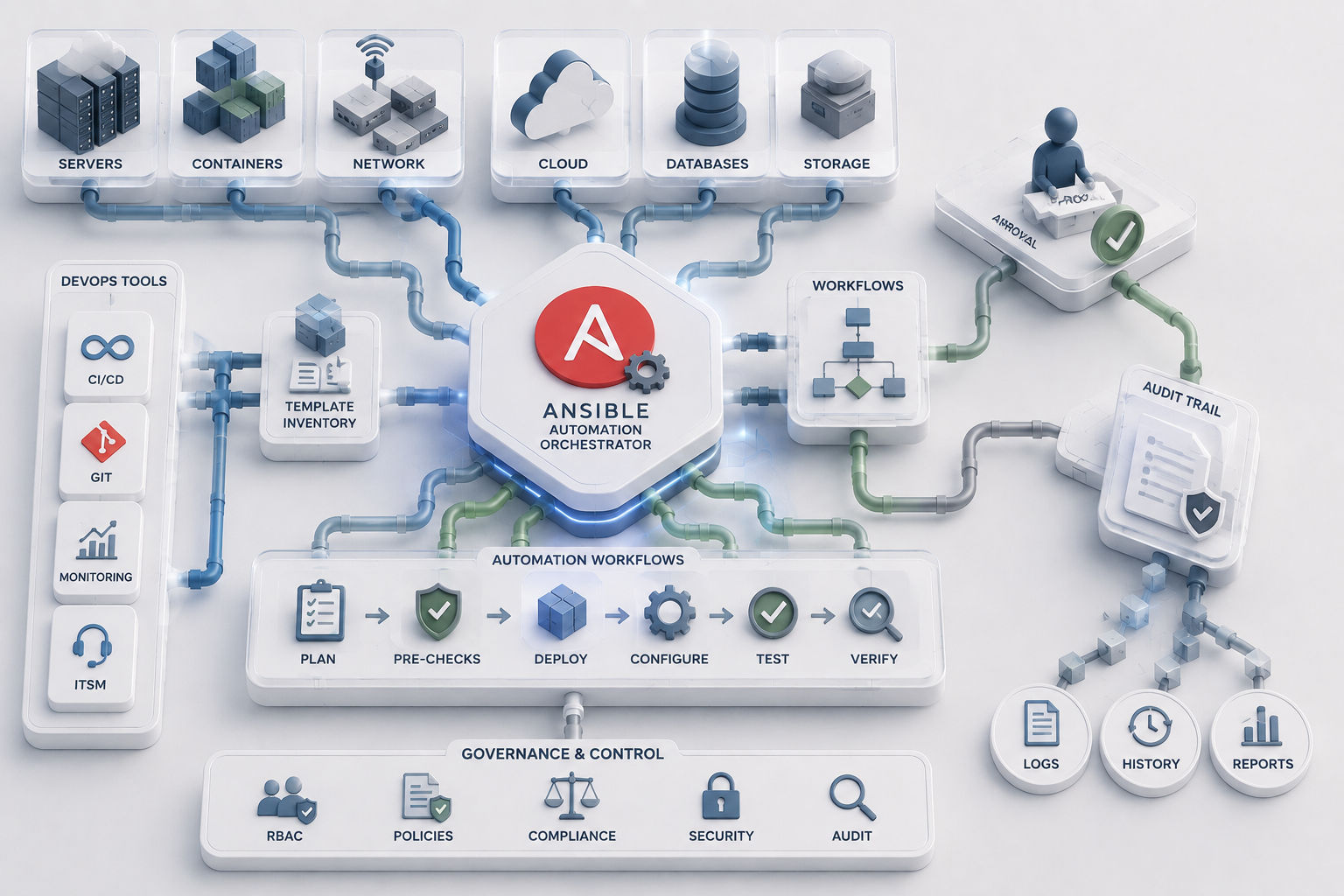
Red Hat’s announcement of a new automation orchestrator for Ansible Automation Platform frames the goal as unifying IT workflows at scale. That is a meaningful signal for organizations with extensive automation that is still operated as disconnected jobs.
What changes when automation becomes a workflow
A playbook remains a useful execution unit, but it is not the whole process. An operational workflow may need an initiation event, input checks, ordered steps, handoffs between teams, failure handling, and a record of decisions. Orchestration is the layer that turns those elements into an intentional flow.
The emphasis is not simply on running work faster. The phrase “unify IT workflows at scale” points toward joining fragmented operational activities. For platform owners, the important question is not whether there is another way to start a job; it is which workflows need centralized ownership and control.
Why governance belongs beside orchestration
As the workflow count grows, so do practical questions: who can trigger a change, what data moves between steps, who owns a stopped run, and what evidence survives an incident? Better YAML alone cannot answer those questions.
Treat orchestration as process design. Keep reusable automation separate from the policy that decides when it may run. That separation can prevent teams from duplicating approval or exception logic across every playbook.
How engineering teams can assess it
- Map one cross-system change, such as patching or environment provisioning.
- Identify human approvals, policy checks, and ownership transitions.
- Separate parallelizable work from genuinely ordered work.
- Define audit and recovery expectations before production rollout.
A high-value workflow with a bounded scope is a better first candidate than a wholesale playbook migration. The point of a pilot is to establish a repeatable operating model, not merely to prove that a chain of tasks can execute.
What to watch next
The announcement suggests that Red Hat is positioning Ansible Automation Platform as a place to organize automation work, not only to store and run content. Teams should watch how the orchestrator connects with the governed content and AI-assisted development themes Red Hat is also highlighting.
Not every task requires centralized orchestration. A small, independent, low-risk job may remain best as a simple job. The value appears when dependencies and accountability have outgrown manual convention.
In 5 Minutes
- Red Hat introduced an automation orchestrator aimed at unifying IT workflows at scale.
- Playbooks execute work; orchestration manages dependencies and responsibility across work.
- Evaluate approvals, audit evidence, and failure ownership with the technical design.
- Pilot one cross-system workflow before expanding the approach.
Image brief for editors
These production notes are not part of the published article. Create and insert the images before approval.
Thumbnail
Suggested placement: Article cover image
Image prompt: Editorial isometric scene of interconnected infrastructure nodes and automation pipelines converging into a carefully organized workflow, with a human approval checkpoint and audit trail represented by neutral geometric symbols, modern enterprise technology illustration, no text, no letters, no logos, no watermark, no interface screens
Suggested alt text: Infrastructure components converging into a governed automation workflow with a control point.
In-article image 1
Suggested placement: After the “What changes when automation becomes a workflow” section
Image prompt: Wide editorial illustration of an operations team coordinating a multi-stage infrastructure change across servers, cloud resources, and a deployment pipeline, clear dependency paths and one controlled decision gate, no text, no letters, no logos, no watermark, no UI
Suggested alt text: Operations team coordinating an infrastructure change through multiple dependent stages.
Sources
- Unify IT workflows at scale with the new automation orchestrator for Ansible Automation Platform
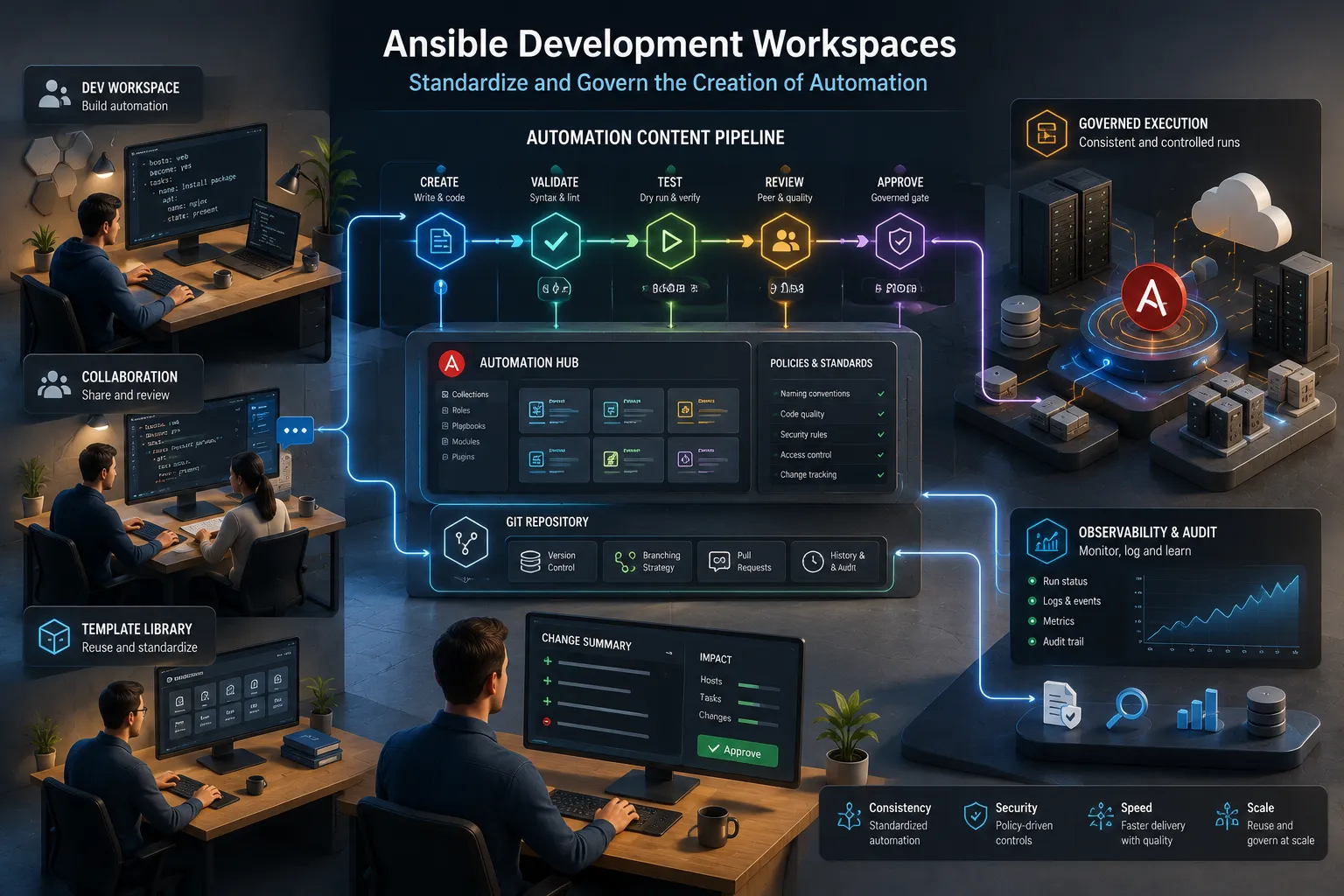
- Red Hat Ansible development workspaces for governed automation content creation
- Accelerate automation with AI and the Ansible development tools MCP servers
- Securing Claude Code plug-ins: Best practices for repository security
- Developer experience improvements you can apply to your own projects
Why developers should care
Automation becomes durable when dependencies, controls, and operational accountability are designed as one workflow rather than scattered across jobs.
Recommended action
- 1Select one cross-system process with multiple handoffs and map its workflow, authorities, and audit evidence before piloting orchestration.