Quick summary
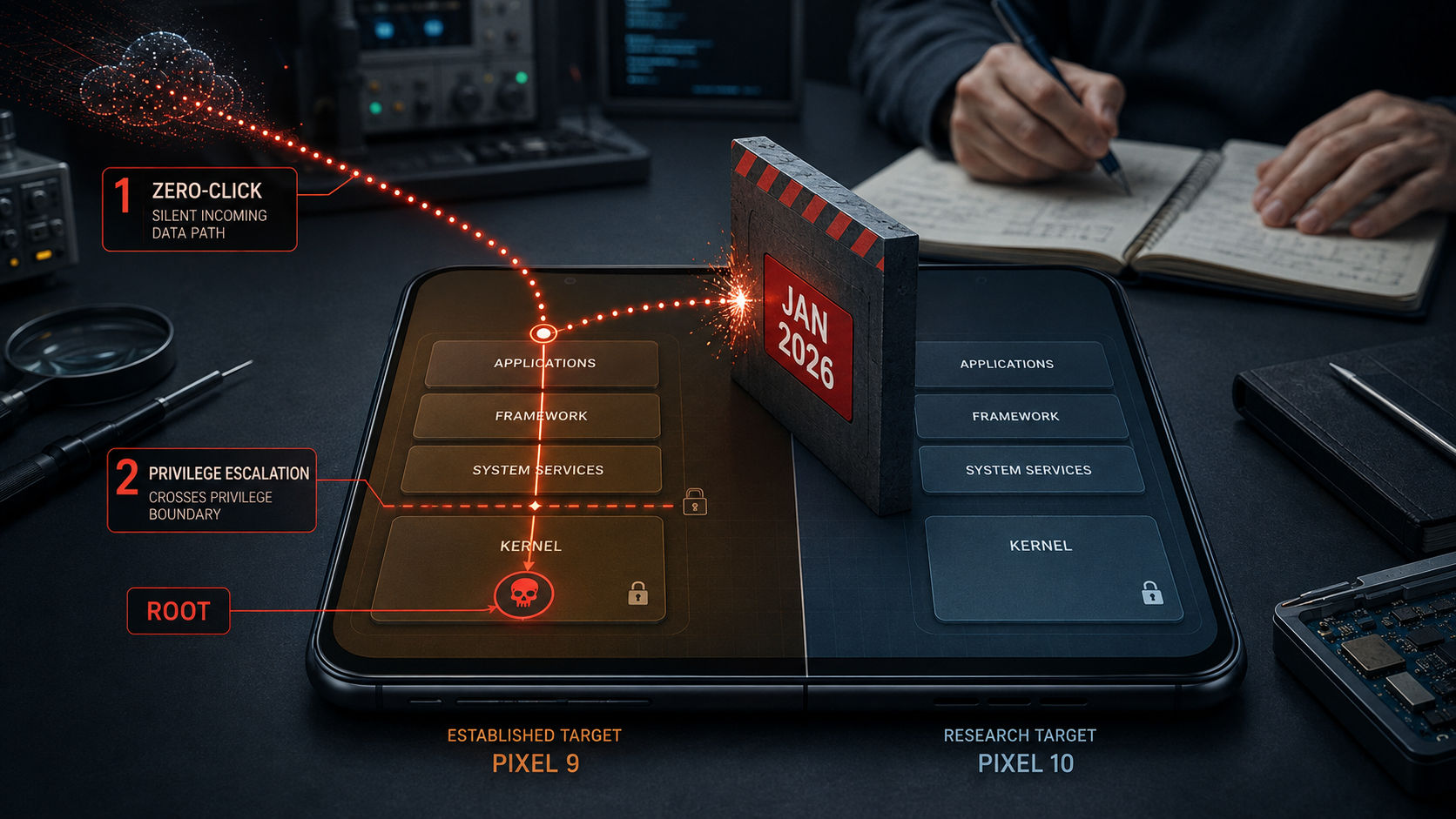
- Google Project Zero says its Pixel 9 exploit chain moved from a zero-click context to Android root using only two exploits. The Dolby vulnerability affected Android broadly until its January 2026 patch, and the researchers are now examining whether a comparable chain can be built for Pixel 10.
- The research illustrates why defenders must assess vulnerabilities as composable attack paths: a no-interaction entry point can become substantially more serious when paired with a privilege-escalation step.
- Verify that managed Android devices carry the January 2026 fix or a later applicable patch, and monitor Project Zero’s follow-up for validated Pixel 10 results and chain-specific technical details.
What happened
The severity of a zero-click vulnerability depends on more than its initial reach. Defenders also need to ask what state it gives an attacker and whether that state can feed another exploit across the next security boundary.
That is the central issue in Google Project Zero’s Updating the Dolby Exploit research. The team says it built a two-exploit chain that progressed from a zero-click context to root on a Pixel 9, then began investigating whether a similar route could be constructed for Pixel 10.
What did the Pixel 9 exploit chain establish?
Project Zero reports that the Dolby vulnerability supplied a zero-click foothold and existed across Android until it was patched in January 2026. A second exploit completed the demonstrated path to root on Pixel 9.
Zero-click means the attack path does not require the target to click a link, open an attachment or approve an action. Root represents a highly privileged position on Android. Reaching the latter from the former therefore involves crossing security boundaries rather than merely triggering one isolated bug.
The supplied material does not identify the exploitation primitives, trigger mechanism, second vulnerability or mitigations crossed by the chain. It would consequently be inaccurate to say that the Dolby flaw alone granted root. The verified claim is narrower and more useful: two exploits were sufficient to connect the initial context to root on the tested Pixel 9.
Why is Pixel 10 a new research problem?
Project Zero frames its next objective as determining whether it is possible to write a similar chain for Pixel 10. That wording does not confirm that the Pixel 9 chain already works unchanged on the newer device, nor does the supplied record provide a final Pixel 10 result.
An exploit chain is an interface between vulnerabilities. The first stage must produce conditions the next stage can consume, while the later stage must remain valid in the target’s software and defensive environment. If an assumption changes between device generations, code reuse alone may not preserve the end-to-end path.
“Updating” an exploit can therefore involve more than adapting it to a different device identifier. Researchers have to establish which assumptions remain stable, which were invalidated by patches or platform changes, and whether a continuous route from the no-interaction entry point to elevated privilege still exists.
What should engineering and security teams learn from it?
First, vulnerability triage should consider composability. A flaw that appears constrained in isolation may carry greater operational risk when its output becomes a reliable input for sandbox escape or privilege escalation. Conversely, removing one indispensable stage can break a chain even if another bug remains reachable.
Second, defenders should separate component-wide exposure from target-specific exploit validation. The researchers describe the Dolby vulnerability as having existed across Android, but the completed chain cited in the record was built for Pixel 9. Those statements establish different scopes and should not be collapsed into a claim that every Android configuration was exploitable to root in the same way.
- Confirm that managed Android devices have received the January 2026 security fix or a later applicable update.
- Model the full attack path during risk reviews instead of treating each vulnerability score as independent.
- During incident analysis, correlate evidence around initial access, privilege-boundary transitions and subsequent privileged activity.
- Retest exploit assumptions against each supported device generation and software build.
For product teams, the broader design lesson is to preserve layered controls. When boundaries are genuinely independent, an attacker must satisfy a fresh set of conditions at every stage. Security reviews should test those handoffs explicitly rather than assuming that isolation at the first vulnerable component contains all downstream impact.
What evidence should readers watch for next?
The most consequential follow-up will be the Pixel 10 result: whether any stages transfer, what has to be replaced, and which platform changes prevent the previous chain from completing. Those details would clarify whether the techniques are portable across device generations or tightly bound to the Pixel 9 environment.
Patch deployment also remains distinct from patch availability. Project Zero states that the Android-wide Dolby issue was patched in January 2026, but the supplied evidence does not describe rollout status for individual manufacturers, carriers or deployed fleets. Organizations should verify the effective patch level of their own inventory rather than infer it from the patch date alone.
Finally, readers should avoid filling gaps in the current record with assumptions about the affected Dolby subsystem or exploitation method. Technical conclusions should wait for disclosed implementation details; operationally, the already verified two-stage chain is sufficient reason to prioritize updates and review detection coverage across privilege transitions.
Conclusion
- Project Zero demonstrated a two-exploit route from zero-click context to root on Pixel 9.
- The Dolby vulnerability reportedly affected Android broadly until its January 2026 patch.
- The available material does not establish that the Pixel 9 chain works unchanged on Pixel 10.
- Defenders should validate real device patch levels and evaluate vulnerabilities as complete attack paths.
Related reading
- Identity security shifts to continuous governance and behavioral detection
- AI agent security must extend beyond the model boundary
- AI agents move from security assistance to active testing and response
Source
Why developers should care
The research illustrates why defenders must assess vulnerabilities as composable attack paths: a no-interaction entry point can become substantially more serious when paired with a privilege-escalation step.
Recommended action
- 1Verify that managed Android devices carry the January 2026 fix or a later applicable patch, and monitor Project Zero’s follow-up for validated Pixel 10 results and chain-specific technical details.