Quick summary
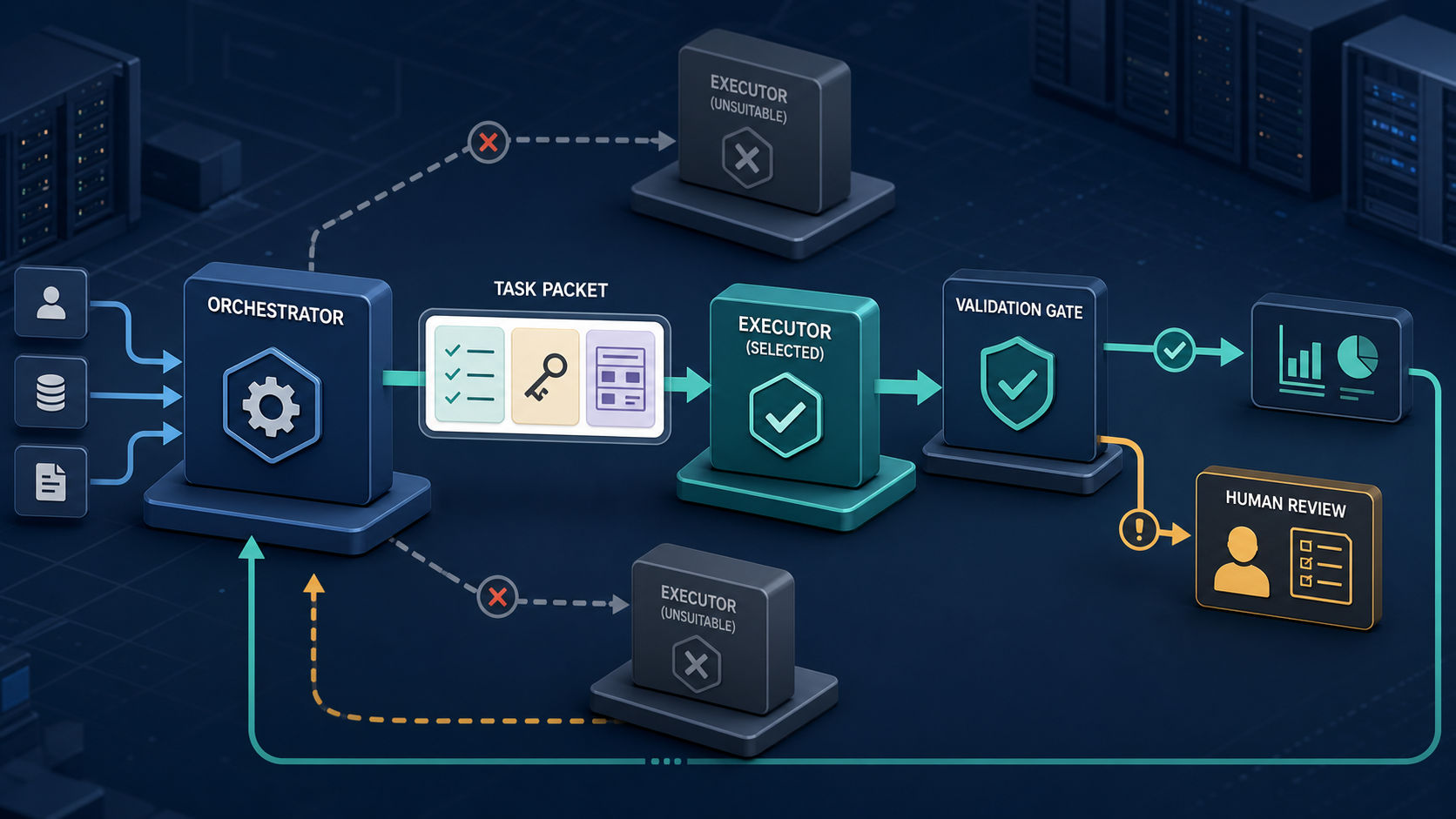
- Reliable delegation is more than passing a prompt from one AI agent to another. It requires an explicit task contract, capability-aware routing, bounded authority, output validation, and traces that explain every handoff.
- A weak handoff can propagate an incorrect assumption across an entire agent workflow while obscuring where the failure began. Treating delegation as a controlled protocol makes agent systems easier to test, secure, and operate.
- Audit one existing agent workflow and add a structured task schema, acceptance checks, authority limits, handoff budgets, and end-to-end tracing before introducing another agent.
What happened
Giving an AI agent access to other agents does not automatically create effective teamwork. The orchestrator still has to decide whether to delegate, choose an appropriate executor, communicate the task without leaking unnecessary context, and determine whether the returned result can be trusted.
Google Cloud's discussion of how agents can delegate better highlights a question that becomes increasingly important as agent workflows expand. For production systems, the useful framing is delegation as an inspectable control protocol rather than an unconstrained conversation between models.
What does an agent decide when it delegates?
The first decision is whether delegation is warranted. A coordinator must distinguish work it can complete directly from work that needs a specialized tool, different permissions, another domain capability, or human judgment.
It must then package the objective as an independently executable task. Forwarding a complete chat transcript is not the same as specifying a task: the receiving agent may have to infer the true objective, inherit irrelevant instructions, or overlook an important constraint buried deep in the context.
Finally, the coordinator needs a disposition for the result. It may accept the output, request a revision, route the task elsewhere, or escalate it. Delegation is therefore a loop of decomposition, routing, execution, and evaluation—not merely another model call.
Build a task contract before adding more agents
A useful delegated task is narrow enough to evaluate but complete enough to execute. Its contract should make the following elements explicit:
- Objective: the desired end state, not an ambiguous instruction such as “take care of this.”
- Inputs: the data and references the executor may use, including which source is authoritative.
- Constraints: permitted tools, authority, time or cost limits, and prohibited actions.
- Output: the expected schema, artifact, decision, patch, or evidence.
- Acceptance criteria: checks that classify the response as accepted, rejected, or requiring review.
Consider an incident-response coordinator. Delegating “fix production” combines diagnosis, decision-making, authorization, and execution in one high-risk instruction. A safer first task is to inspect an approved set of telemetry, rank hypotheses against the available evidence, and return a remediation proposal without changing the environment.
A separate policy gate can decide whether any proposed action should run and which identity may run it. This resembles the separation used in a governed automation control plane: orchestration applies policy while an executor receives only the authority needed for a specific job.
How should an orchestrator route work and share context?
Routing should rely on machine-readable, testable capability descriptions rather than friendly agent names. A registry can describe accepted task types, required permissions, supported tools, output contracts, and operational limitations. Those claims should be verified during onboarding and monitored as components change.
Explicit routing rules are often easier to test at the beginning. If a model selects the route, it should still operate within an allowlist, a handoff budget, a maximum delegation depth, and predefined fallback paths. These controls prevent an uncertain agent from spawning an open-ended chain of retries.
Context should follow least-privilege principles as well. The receiving agent needs the information required to perform the task, not the coordinator's entire memory, credentials, or conversation history. A structured brief, authorized data references, and a correlation identifier are usually more controllable than an unrestricted context dump.
Every additional handoff creates another opportunity for intent to drift. Child agents should return not only an answer but also relevant evidence, confidence or uncertainty signals, and a machine-readable status. The parent can then apply validation rather than judging polished prose as proof of correctness.
How do teams evaluate delegation in production?
Evaluating only the final response hides where a workflow failed. Tests should separately ask whether delegation was necessary, whether the task was decomposed correctly, whether routing selected an eligible executor, and whether the result met the declared acceptance criteria.
Offline scenarios can include incomplete context, conflicting instructions, unavailable tools, permission denial, malformed output, repeated timeouts, and an executor that cannot complete the task. The desired behavior is not always success; sometimes the correct outcome is to stop, expose uncertainty, or request human review.
Production traces should connect the original request to every handoff, tool call, validation step, retry, and escalation. Useful records include policy and component versions, sender and receiver identities, timing, resource usage, validation outcomes, and termination reasons. Sensitive prompts and data still require access controls, redaction, and an appropriate retention policy.
Agent delegation also affects latency and infrastructure cost because a single request can branch into multiple executions. Teams operating production AI and model-serving infrastructure should treat handoff depth, parallelism, retries, and token use as governed resources rather than invisible implementation details.
What is a practical adoption path?
Start with a read-only workflow whose outputs can be checked deterministically or reviewed cheaply. Require approval for side effects, cap the number of handoffs, and define a clear stop condition before measuring completion quality.
Next, review traces to find recurring decomposition and routing failures. Improve contracts and policies before adding more autonomy. Better orchestration usually comes from clearer interfaces and operational feedback, which aligns with the broader role of developer experience in platform engineering.
Only expand authority when evaluation demonstrates acceptable behavior for both normal and adversarial cases. Autonomy should be an earned operational property, not a switch enabled because individual demonstrations look convincing.
Conclusion
- Model delegation as a contract with explicit inputs, constraints, outputs, and acceptance checks.
- Route by verified capability and share only the minimum context and authority required.
- Evaluate the delegation decision, task decomposition, executor choice, and final output separately.
- Bound depth, retries, cost, and side effects, with a defined path to human escalation.
- Increase autonomy only when production traces and repeatable evaluations justify it.
Related reading
- DevOps for Production AI: Optimizing GPUs and Model Serving
- Ansible Automation Orchestrator: Designing a Governed Control Plane
- Developer Experience Is the Connecting Layer in Red Hat’s New DevOps Push
Source
Why developers should care
A weak handoff can propagate an incorrect assumption across an entire agent workflow while obscuring where the failure began. Treating delegation as a controlled protocol makes agent systems easier to test, secure, and operate.
Recommended action
- 1Audit one existing agent workflow and add a structured task schema, acceptance checks, authority limits, handoff budgets, and end-to-end tracing before introducing another agent.