Quick summary
- Production AI is expanding the DevOps remit from container deployment to GPU capacity, inference policy, reproducible experimentation, and model lifecycle control. OpenShift-focused guidance outlines how these concerns can form one operational stack without collapsing them into a single scaling problem.
- GPU waste, uneven inference demand, and fragile model environments can undermine both cost and reliability. Engineering teams need connected controls for capacity, service priority, artifacts, and observability before AI workloads scale.
- Baseline one GPU-backed inference service across utilization, queueing, latency, failures, and output quality, then trial one optimization at a time before encoding it in GitOps.
What happened
Operating an AI model in production is not simply another container deployment. Teams must coordinate scarce GPUs, mixed-priority inference traffic, large model artifacts, and experimental environments that can change faster than conventional application dependencies.
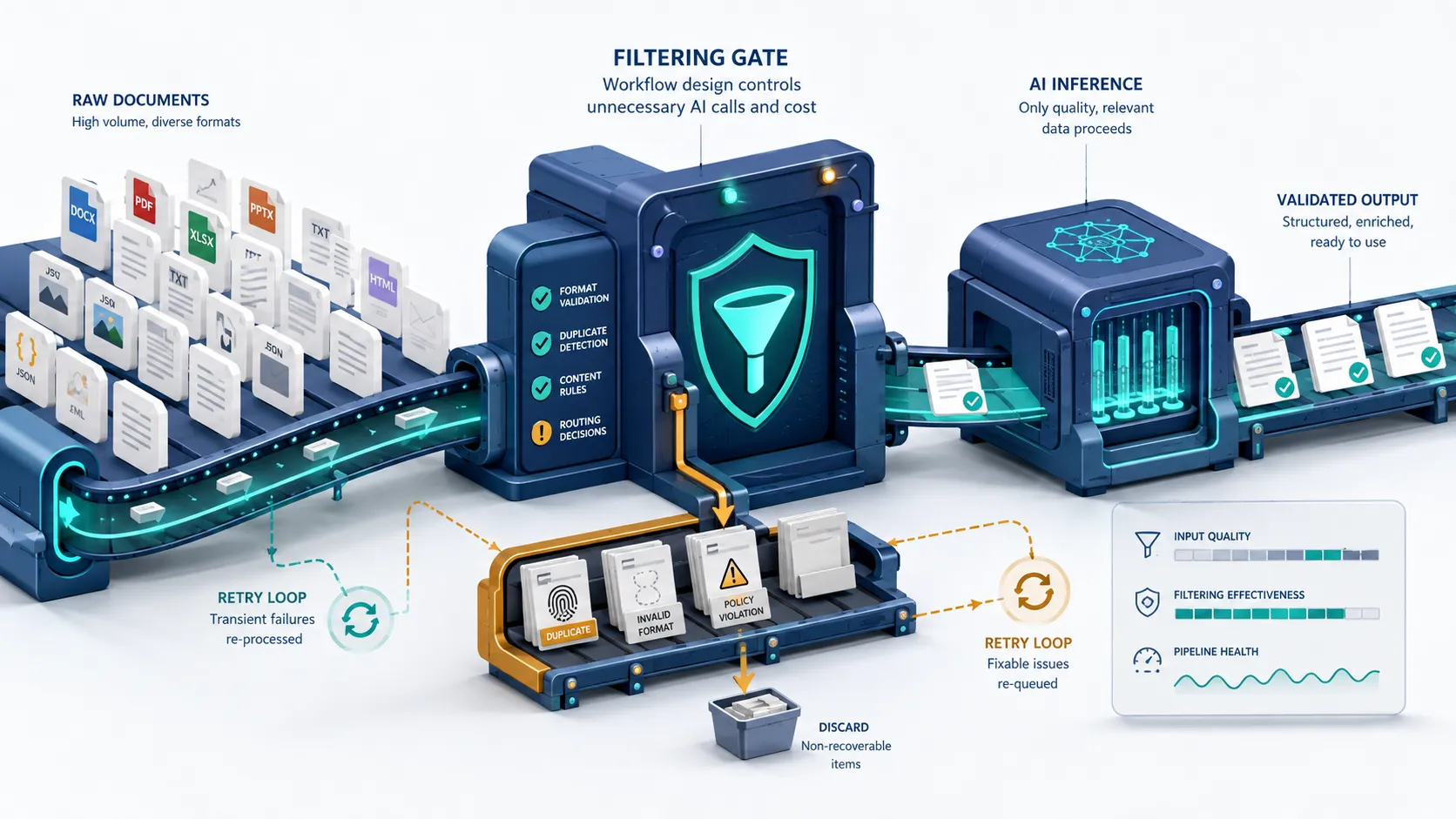
A set of OpenShift AI-oriented guides points to a broader DevOps pattern: manage compute capacity, model serving, and the model lifecycle as connected control planes. The practical goal is not to adopt every tool at once, but to make performance and resource decisions measurable and reversible.
Why does production AI change the DevOps problem?
Conventional services are commonly planned around CPU, memory, request volume, and replicas. AI platforms add GPU scheduling alongside interactive notebooks, batch training, RAG pipelines, fine-tuning jobs, and latency-sensitive inference endpoints.
A successful GPU allocation does not prove that useful work is taking place. The guidance on reducing wasted Kubernetes GPU allocation with GPU-pruner makes capacity reclamation an operational concern. Teams therefore need to distinguish resources that are reserved from resources that are productively used.
Request value also varies. Internal evaluations and background jobs may share infrastructure with user-facing calls, yet simple first-in, first-out processing cannot express that difference. The llm-d priority-queuing approach for shared GPU inference shows how service policy can become part of the serving layer.
Taken together, these examples suggest that AI infrastructure needs two separate feedback loops. Capacity control asks whether a workload should retain a GPU; flow control asks which request should use available inference capacity next.
How should teams control GPU serving capacity?
A useful design separates allocation, admission, and model efficiency. Treating all three as a replica-count problem hides whether a latency regression comes from contention, an oversized model, inappropriate request ordering, or genuinely insufficient capacity.
| Operational question | Primary control | Evidence to collect |
|---|---|---|
| Is allocated GPU capacity doing useful work? | Allocation review and reclamation | Idle time and GPU utilization |
| Are important requests delayed by lower-value traffic? | Priority classes and queues | Latency by class and queue depth |
| Does the model fit the serving envelope? | Quantization evaluation | Memory use, throughput, and output quality |
Quantization uses lower-precision numerical representations for model weights or computation. It may improve the deployment fit, but its effect depends on the model and workload. The LLM quantization guide provides deployment-oriented guidance; production adoption should still be gated by task-specific quality tests rather than infrastructure metrics alone.
RAG adds another boundary. Retrieval, context assembly, generation, and downstream handling form a pipeline whose behavior cannot be understood from the model endpoint alone. The guide to orchestrating production RAG with OpenShift AI reinforces the need to operate those stages as one service path.
For developers, that means tracing and service objectives should follow the whole request. A fast generation step cannot compensate for failed retrieval, while more GPU capacity will not fix irrelevant context.
What makes the model lifecycle reproducible?
Operational reliability starts before deployment. Notebooks that download mutable packages or depend on undocumented setup steps make results difficult to reproduce. The work on hermetic notebook images for Open Data Hub and OpenShift AI treats the development environment as a controlled, versioned artifact.
Fine-tuning then introduces its own resource and evaluation decisions. The supplied guidance covers both LoRA fine-tuning with Ray on OpenShift AI and GRPO using verifiable rewards. These are not interchangeable recipes: teams should select an approach according to the intended behavior, available evidence, evaluation method, and compute budget.
Every run should produce traceable metadata as well as model weights. The overview of AI observability with MLflow connects experiment and model tracking to operations. For that connection to remain useful, the training run, model version, serving configuration, and production measurements need consistent identifiers.
This resembles a governed automation control plane more than an isolated MLOps dashboard. The same separation of desired state, execution, access, and auditability discussed in governed control-plane design can inform how teams automate model promotion and infrastructure changes.
What is a low-risk rollout plan?
Adopting every component simultaneously would make regressions hard to attribute. Start with one GPU-backed service that has measurable traffic, a defined quality evaluation, and clear user classes.
- Establish a baseline: record GPU allocation and utilization, queue depth, percentile latency, failures, throughput, and output-quality results.
- Classify workloads: separate notebooks, fine-tuning, batch inference, and online inference; identify which jobs can wait, move, or lose an idle allocation.
- Define serving policy: document priority classes and overload behavior before implementing queues.
- Version the chain: track notebook images, training configuration, model artifacts, serving parameters, and deployment manifests together.
- Automate cautiously: Helm and GitOps can carry reviewed desired state, but promotion should include policy checks, evaluation gates, and rollback.
This sequence is an architectural recommendation rather than a claim that one OpenShift configuration suits every organization. Quantization, request priority, and GPU reclamation should first be tested independently, with business and quality outcomes considered alongside infrastructure utilization.
Conclusion
- Production AI DevOps has distinct capacity, traffic-control, and model-lifecycle layers.
- GPU reclamation and priority queuing address different problems and should be measured separately.
- Reproducible notebook images and linked metadata make model behavior easier to audit.
- Roll out one control at a time, preserve a baseline, and make every production change reversible.
Related reading
- Ventura React: Is this lightweight component library still fit for new projects?
- Nova MCP turns Cursor and Claude into a product-building team
- Ansible Automation Orchestrator: Designing a Governed Control Plane
Sources
- Run LoRA fine-tuning on Red Hat OpenShift AI with Ray
- Building hermetic notebook images for Open Data Hub and Red Hat OpenShift AI
- llm-d flow control: Priority queuing for shared GPU inference
- How AI observability works with MLflow
- GRPO fine-tuning on Red Hat OpenShift AI: Reinforcement learning from verifiable...
- LLM quantization guide: How to do it, and how it helps
- Orchestrate production RAG with OpenShift AI
- Stop wasting GPU allocation in Kubernetes with GPU-pruner
Why developers should care
GPU waste, uneven inference demand, and fragile model environments can undermine both cost and reliability. Engineering teams need connected controls for capacity, service priority, artifacts, and observability before AI workloads scale.
Recommended action
- 1Baseline one GPU-backed inference service across utilization, queueing, latency, failures, and output quality, then trial one optimization at a time before encoding it in GitOps.