Quick summary
- Google Cloud is highlighting the economics of integrating generative AI into Dataflow-based data workflows. Engineering teams should evaluate the entire processing path—from input selection and inference frequency to retries and output handling—not merely the model call.
- GenAI costs can scale with both data volume and workflow behavior. Instrumenting the full pipeline gives teams a better basis for controlling waste, validating architecture choices, and deciding when a workload is ready to scale.
- Instrument one representative GenAI workflow and establish a baseline for inference rate, retries, validated outputs, and cost per useful result before changing architecture or increasing traffic.
What happened
A generative AI step can turn an ordinary data pipeline into a content enrichment or transformation workflow. It also introduces a variable-cost operation whose frequency depends on upstream filtering, routing decisions, failures, and retry behavior.
Google Cloud’s discussion of cost-effective GenAI workflows in Dataflow focuses attention on that operational problem. The supplied crawl record does not include product configurations, prices, or benchmark results, so those details should not be inferred; the practical lesson is to treat cost as an end-to-end workflow property.
Why is the model bill only part of the picture?
Inference is the most visible new expense, but it does not operate in isolation. A production workflow also reads, transforms, routes, and writes data, while unsuccessful work can consume capacity without delivering a usable result.
For planning purposes, teams can separate spending into three analytical buckets: data processing, model inference, and operational overhead. This is a design framework rather than a Google Cloud pricing formula, but it makes hidden amplification factors easier to find.
| Cost driver | Question to investigate | Useful signal |
|---|---|---|
| Input volume | Does every record require AI processing? | Share of records reaching inference |
| Repeated work | Are duplicates or unchanged inputs processed again? | Duplicate and replay rate |
| Request size | Is unnecessary context included? | Input size by task type |
| Failures | Do retries multiply expensive operations? | Attempts per successful result |
| Output handling | Which intermediate results must be retained? | Storage written per completed task |
This decomposition prevents a misleading optimization in which a cheaper model call is offset by more retries, duplicated processing, or additional pipeline work.
Where should inference sit in the workflow?
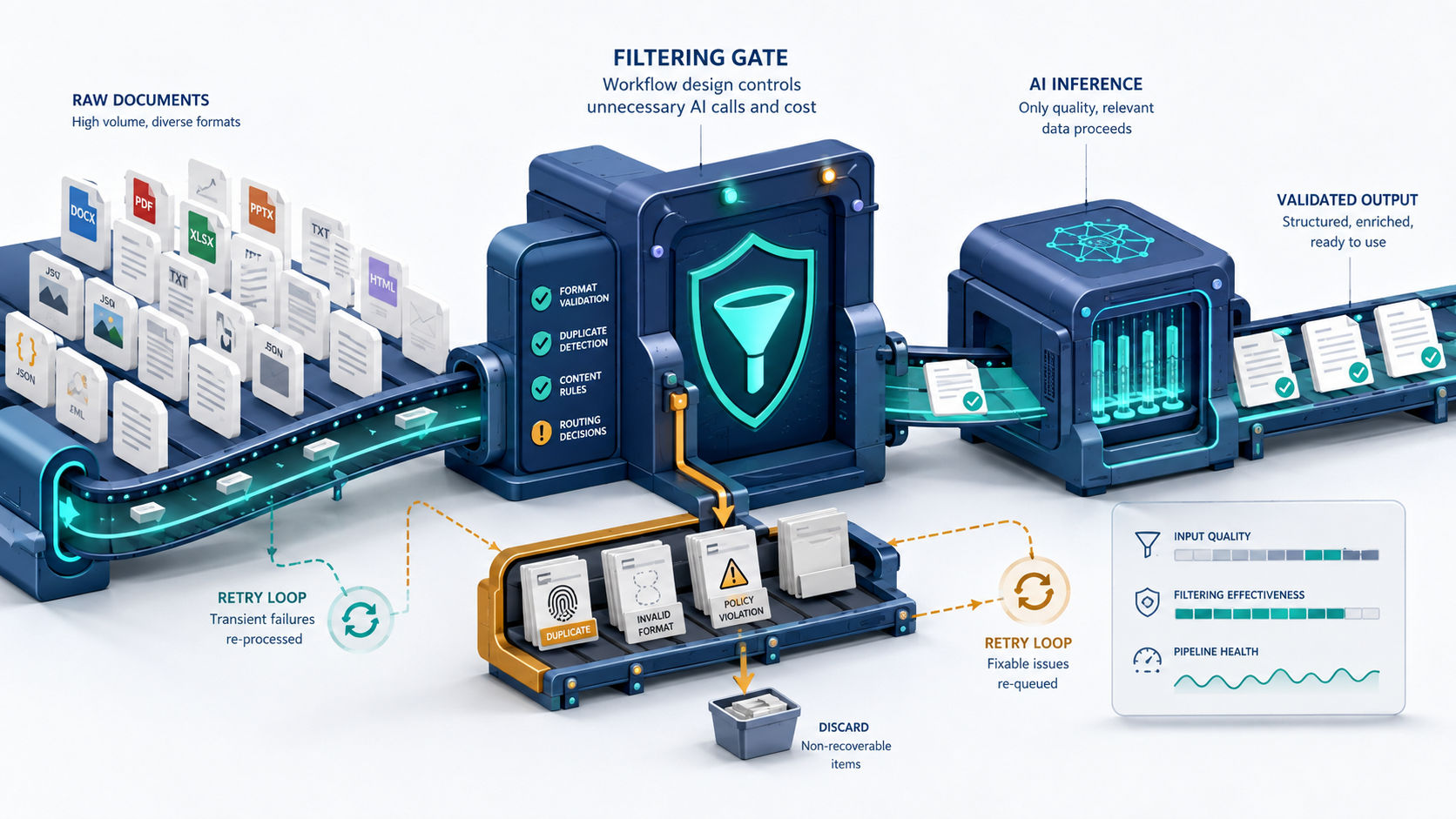
The architecture should make a deliberate decision about which inputs reach the model. Validation, deduplication, normalization, and task-based routing can happen before inference so that malformed, repeated, or irrelevant records do not trigger avoidable requests.
After inference, the pipeline needs to distinguish transport success from a usable application result. A completed request can still produce output that does not meet the workflow’s requirements, so teams should define validation and fallback behavior rather than treating every response as equivalent.
The resulting conceptual path is straightforward: ingest, validate, deduplicate, route, infer, validate the result, and persist only what is needed. This sequence is a general engineering recommendation, not a claim about a particular Dataflow template or connector.
Which measurements support sound optimization?
A baseline should precede tuning. At minimum, capture input count, the proportion sent to inference, completion rate, retry count, processing duration, and the number of outputs that pass application validation.
The strongest economic metric usually connects cost to useful output. Cost per successfully enriched document, for example, separates productive growth from an increase caused by waste, although each team should select a unit that matches its own use case.
Pipeline telemetry should also be correlated with the serving layer rather than reviewed in separate dashboards. The broader operational considerations in DevOps for production AI and model serving optimization help frame that end-to-end view.
How can teams test the design without an expensive surprise?
Start with a bounded, representative sample and document the assumptions behind expected traffic, output quality, and failure rates. Change one control at a time—such as an input filter or retry policy—so its effect can be distinguished from normal workload variation.
- Define one use case and a measurable acceptable result.
- Map every transformation before and after inference.
- Set explicit traffic and spending limits for the experiment.
- Observe filtering, inference, validation failures, and retries as one traceable flow.
- Scale only after cost per useful result and operational behavior are acceptable.
Production readiness also requires controlled configuration changes, ownership, and an audit trail. Those concerns overlap with the platform discipline described in designing a governed automation control plane and with treating developer experience as a platform engineering layer.
Conclusion
- Evaluate GenAI economics across the complete data path, not only the inference request.
- Use pre-inference filtering and routing as measurable cost controls.
- Track useful validated outcomes alongside infrastructure and model consumption.
- Scale from bounded experiments only after retry and failure behavior is understood.
Related reading
- DevOps for Production AI: Optimizing GPUs and Model Serving
- Ansible Automation Orchestrator: Designing a Governed Control Plane
- Developer Experience Is the Connecting Layer in Red Hat’s New DevOps Push
Source
News, tips, and inspiration to accelerate your digital transformation
Why developers should care
GenAI costs can scale with both data volume and workflow behavior. Instrumenting the full pipeline gives teams a better basis for controlling waste, validating architecture choices, and deciding when a workload is ready to scale.
Recommended action
- 1Instrument one representative GenAI workflow and establish a baseline for inference rate, retries, validated outputs, and cost per useful result before changing architecture or increasing traffic.